“Every person you meet knows something you don’t; learn from them” (H. Jackson Brown Jr.)
Maternal mental health research has the power to shape care and policy – but only when the voices of those most affected are meaningfully involved.
At PenARC, we recently led an online seminar exploring public involvement in maternal mental health research, bringing together researchers, clinicians, and people with lived experience from across the UK and beyond. The session focused not only on why public involvement matters, but on practical examples of how co-production and participatory approaches can be done well, ethically, and with real impact.
Bringing people together
The seminar opened with a welcome from Professor Heather O’Mahen, Chair of the session, Professor of Perinatal and Clinical Psychology at the University of Exeter, and PenARC Mental Health Theme Lead. Heather outlined the aim of the webinar: to bring together people with a shared interest in co-production – particularly in mental health and family research - to learn from each other and build new connections.
Beccy Summers, PenARC Postgraduate Research Associate, then kicked things off with an interactive session using Mentimeter. Participants were invited to reflect on how they were feeling, what drew them to maternal and family mental health research, and what they hoped their work would achieve.
Across diverse roles and locations – from Exeter to London to Austria – shared motivations quickly emerged: improving care, reducing inequalities, supporting families, creating social justice, and making it easier for people to ask for help. Participants were also honest about the challenges of co-production, including time pressures, power sharing, inclusivity, funding constraints, and navigating academic systems. At the same time, many described co-production as fun, relationship-building, and a constant source of learning.
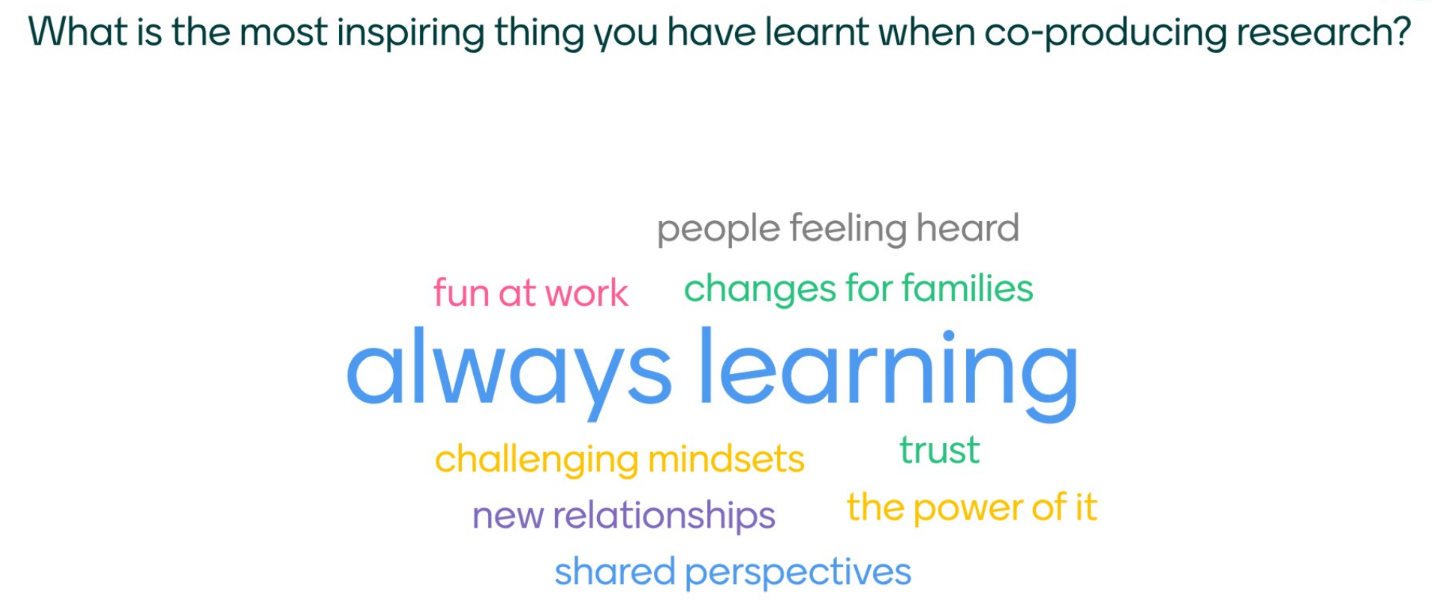
Responses to the question ‘What is the most inspiring thing you have learnt when co-producing research?’ are shown in the word cloud below:
Setting the scene: what do we mean by involvement?
An introduction to public involvement grounded the discussion in the NIHR definition of public involvement: research carried out “with” or “by” members of the public, rather than “to”, “about”, or “for” them. While terminology varies across organisations and communities, the shared emphasis was on collaboration, respect, and co-production.
To deepen this framing, attendees were shown a video of Holding Spaces, a poem created by members of the public involved in four ARC research projects on child and maternal health, as part of the NIHR Children’s Health and Maternity Priority Programme, co-led by PenARC and ARC Yorkshire and Humber. One line resonated strongly:
“Collective minds, we all come together like waves across the shore, to make the world a better place.”
You can read the full poem here.
Co-designing community support: learning from Austria
The first presentation came from Dr Jean Paul, Assistant Professor in participatory mental health research at the Medical University of Innsbruck, Austria. Drawing on over eight years of interdisciplinary work, Jean shared learning from two participatory research projects - Village and Healthy Minds - both focused on strengthening mental wellbeing for families.
Jean highlighted how participatory approaches helped centre the voices of children and families, particularly those where a parent is living with mental illness – a group often identified late and with limited coordinated support. The Village project brought together health, education, and social care professionals with families to co-design sensitive screening processes and strengths-based interventions. Outputs included practical toolkits, an implementation model, and even a co-created comic book for children – all shaped directly by lived experience.
Importantly, Jean emphasised that analysis itself is a reflective process, requiring researchers to stay mindful of assumptions and remain open to challenge. While traditional academic outputs were achieved, the work also led to tangible changes in services across Austria, demonstrating how co-design can translate research into practice.
The Healthy Minds project built on this learning, focusing on the transition to parenthood and addressing gaps in perinatal mental health care. Through co-design workshops and system mapping, the project highlighted regional disparities, stigma, fragmented services, and the importance of local context - showing how combining evidence with lived experience can bridge research and real-world care.
Co-producing sensitive research: learning from the RIVA programme
The second presentation was delivered jointly by Vita Moltedo, Peer Researcher, and Dr Kylee Trevillion, Senior Lecturer at King’s College London, who spoke about their work on the RIVA project, focused on evaluating models of health based Maternity Violence Advisor (RIVA) provision in maternity services.
Their reflections offered a powerful insight into what co-production looks like in practice, particularly in sensitive research areas. Vita shared her journey into peer research, describing how lived experience helped her realise she did not need to be a passive recipient of care - and how finding and using her voice became an empowering act, not just for herself but for others.
Both speakers reflected honestly on challenges, including imposter syndrome, power dynamics, and the emotional demands of the work. They emphasised the importance of trust, active listening, clear expectations, and creating safe spaces - from informal check-ins to social activities that helped build a sense of community among peer researchers and academics.
Kylee described how peer researchers were involved across multiple stages of the RIVA study, from interviews and analysis to publications, training packages, and critical lived experience commentaries written in peer researchers’ own voices. She reflected on how involvement had not only strengthened the research but had made her a more reflective researcher - and person.
Reflections and looking ahead
Discussions with attendees reinforced several key themes. Lived experience matters, and people do not need academic qualifications to contribute meaningfully to research. Skills gained through caregiving, community roles, and everyday life are often undervalued, yet essential to understanding what truly works for families.
Speakers and participants alike reflected on the need to challenge traditional research metrics and narrow definitions of impact. Co-production can feel risky and resource-intensive, but it brings humanity, creativity, and relevance to research – and often leads to outcomes that matter more to practitioners and families.
As one reflection noted, resistance to change is natural, but involvement is not about adding another requirement; it’s about making research better. Even small steps towards involvement can be powerful.
The seminar closed with a shared hope for continued connections and learning across the next phase of the NIHR ARCs – recognising that meaningful public involvement is not a one-off activity, but an ongoing conversation.
Author